Sunday, 12 November 2017

Moving Moments Ch.17 - The End of the Beginning

Moving Moments
Chapter 17
The End of the Beginning

Elaine and Julia. They were such sweet little tiddlers
Our SU lives kept us very focused. Did we have much of a life outside of SU? In fact we did manage to keep some other things on the go which meant we were busy to say the least.

It was fun to see the girls growing up and beginning to do all the things that little girls do. Piano, ballet and swimming lessons, along with a fair dose of birthday parties were all part of the mix. Probably our source of most satisfaction was in how the girls were so happily involved in all of the SU activities that we were. They got to see camps and holiday clubs happen from the ground up. When the activities came along they were thoroughly involved as campers. They became veteran campers and no doubt would have ended up becoming one of the teenage leaders at some point, who they so ardently looked up to.

Julia on right in one of her school
dramatic productions
Julia and Elaine with their collection of buddies. 
Julia and Elaine attended Clarendon Prep and Primary school respectively. This was a five minute drive from our house. Like many of the East London government schools, the standard of teaching and quality of education was akin to a very pricey private school. Clarendon was a girl’s only school  and many of the teachers were Christians, which of course gave it its own unique flavor. There was an SU group at the Primary school, which Elaine attended faithfully along with her buddies. Cher and Audrey Anderson both ran that group. Clarendon was “old school” in many of its practices and policies. When the teacher entered the classroom the girls had to stand up and greet her and could only sit when the teacher gave permission. This mimicked our own upbringing in Northern and Southern Rhodesia and we thoroughly approved this.

Julia - student at
Clarendon Prep
Elaine - student at
Clarendon Primary
After two or three years of living at the SU house, SU began to grow and needed more space. As it happened we were ready to move out. The SU house was on the edge of a low income area and it was quite common to have beggars coming to our front door asking for food. We would go into the kitchen, make some sandwiches and duly deliver them, with a piece of fruit. It wasn’t uncommon for the individuals to look at our bread sandwiches in disgust and throw them down the passage back at us. They were looking for money and our offering didn’t impress them. These fairly regular visitations also meant that we had to be more on guard security wise. We still had the money from the sale of our house in Johannesburg and decided it was time to buy a house of our own. We would regain our privacy and we could choose a part of the city we’d like to live in.

Cher’s sister Lynne, and husband Glenn Paterson had moved back to East London a year or two earlier as Glen had been transferred there with his job. They were living in Nahoon, which was a nice quiet suburb on a main road heading towards Nahoon Beach. Naturally Cher wanted to live close to her sister, and so it was that we ended up a couple of small blocks from them at 67 Kennington Road. Our house was small but in great condition. We had a nice front yard but a huge back yard which dipped down at the back and overlooked a dambo, which is a type of wetland. About a quarter of a kilometer away we could see the next row of houses on the other sider of the dambo. After the craziness of the SU house we felt very privileged to have such a beautiful, private outlook all to ourselves. We began to settle down to life in the ‘burbs’.

It was around this time that I started to have a real problem with sleeping at night. My SU responsibilities kept me very busy and I would often go to bed my head buzzing with the doings of the day. This would be followed by hours of sleeplessness, often only relieved when I would get up to do some of the work that was keeping my mind so occupied. This wasn’t a healthy way to conduct my life as I don’t function too well with lack of sleep. I guess we had been praying about it when a thought dropped into my mind – “maybe I should cut out my 10pm cup of coffee” which I was used to enjoying before bedtime. I suppose our bodies change and at some point I couldn’t tolerate as much caffeine. I cut out the late night coffee and lo and behold I got my sleep back for the most part. I’m grateful to the Lord for leading me to this simple conclusion otherwise I might have been a basket case in the not too distant future.

Some of our SU Band of Brothers
L to R. - Mike Smallbones, Peter Holmes (SU National
Director) & Daryl Henning
One of the things which my SU work entailed was getting together once or twice a year with all of the Area Directors from the rest of South Africa. There were about 8-10 of us. It was always a time of good fellowship. Iron sharpens iron and so it was with us. At that time we were all men. We were a band of brothers on a mission together. At the same time as we were encouraging one another, we were actually spurring one another on to greater things. We would have times of worship together. There is something uniquely inspiring about men, who are sold out to God, singing lustily to God at the top of their voices. I used to come away from these meetings both inspired and motivated but also sometimes feeling the burden of not being able to keep up with all of the super talented guys we had on our national team, lead by Peter Holmes.

I was Presbyterian, but most of the rest of our leadership group were died in the wool Baptists. At that time in South Africa there was a lot of buzz about “Signs and Wonders” teaching that was coming in and young people were flocking to charismatic churches where they found openness to this approach. SU was the largest youth ministry in the country and we were beginning to feel that we might be losing touch with our audience. We needed to get up to speed with all the Signs and Wonders phenomena. John Wimber, from California, was one of the leaders at the forefront of this teaching. Cher and I had first encountered John Wimber whilst at Bible College in UK, when one of our classes was visited by the Holy Spirit in a wonderful and memorable way inspired by a guy who had attended a John Wimber conference in London.  He was going to be in Johannesburg for a week of teaching to church leaders, so our group of rather died in the wool, stodgy evangelicals decided to risk life and limb and go and see what he had to say. We also decided to encourage other SU staff around the country to go aswell. We held our breath and made our way to Johannesburg at the appointed time. I was excited. If God had something going on and we were missing out, I wanted to know about it and be part of it.

John Wimber's teaching had a big impact on me. 
John Wimber was a breath of fresh air. His teaching was fascinating but not at all scary or weird. He told his story of how he had come into this type of ministry from a drugs and rock and roll background. When he came to the Lord, his background was so unchurched that he expected that the miracles and signs and wonders told of in the Bible were to be the norm for this day and age too. The stories are too many to tell, but the bottom line is that he recounted how as he prayed to God for modern day miracles, God began to lead him into a ministry in this direction. It started with “words of knowledge”, which gave an insight into how God was wanting to work and who and how people should be prayed for. With this type of prayer, there was a far higher rate of “successful outcomes”. He also showed how the disciples were initially a stumbling, bumbling bunch of regular men who needed to practice and hone their ministry skill set before they could effectively pull off miracles for themselves. He encouraged us to pray expectantly and then put into practice some of what we had learnt from him. The bottom line was that we began to practice asking God how we should pray for people and situations and then listen for any words of knowledge which might come and then pray accordingly. We don’t need to fear “failure” as it is our job to ask, and it’s God’s role to answer. Responsibility for the outcome of our prayers resides with God. I found this a very releasing approach. If things didn’t work out as I wanted or expected, it didn’t matter. The outcome was in God’s hands.  As an SU leadership team our week with John Wimber represented a step forward as we embraced a greater openness to the work of the Holy Spirit in our personal lives and ministries.

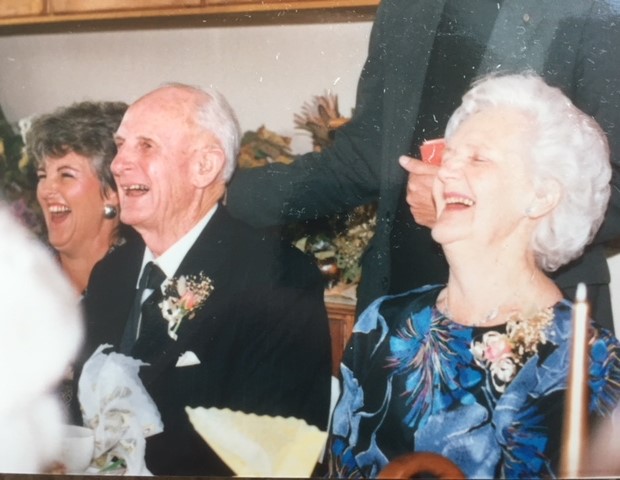
Mom and Dad in their golden years
During the week with John Wimber I had been staying with Mom and Dad in Boksburg. Dad had been suffering a lot of physical discomfort with a very painful hip. I was coming home each day from the John Wimber conference and giving Mom and Dad a blow by blow account of what was happening, including some of the signs and wonders. Mom was interested and Dad was polite. He was not a Christian. His pride was holding him back from 25 – 30 years ago when my sister Rose had come home from UK to Chingola, in Zambia, as a newly minted Christian, to announce to her family that we were “ all heathens and needed to be saved, otherwise we were all going to hell”. Whilst this statement may have been true it had not gone down well, especially with Dad. He had hunkered down and refused to countenance Christianity from that time on. At the end of the week with Mom and Dad, as I was heading out of the door to catch my plane, I finally plucked up the courage to say to Dad, “Dad all week we have been praying for people to be healed of various ailments and we have seen some amazing miracles. How’s about we pray for your hip and perhaps the Lord will heal you?” I think Dad was so desperate with the pain in his hip he didn’t feel he had anything to lose, so he agreed. I prayed and as far as I could tell nothing happened, nor did Dad feel any improvement. I was disappointed, but said to him, “Dad, don’t lose heart. Maybe God will still heal you over the next few days”, and then I left for the airport.

Jesus knocks patiently at the
door of our lives
About three weeks later, Cher and I had to be in Johannesburg for a family event and another SU meeting. We drove up to Johannesburg and were discussing why nothing had “happened” when I had prayed for Dad. As I was reflecting on it, a word dropped into my mind. John Wimber, describes a word of knowledge as a “whis” or half a whisper. It’s a thought, that is half heard and there is no certainty that it is more than just one’s imagination. Nevertheless one prays in faith, trusting that it is God who has spoken and not just our minds playing tricks. The word didn’t reflect well on Dad or his character. I wondered if the word that had dropped into my mind was a word of knowledge. A couple of days later, we were having a family gathering and I decided I would get Dad in a corner and talk to him on his own. I found my opportunity and asked him, “Dad has there been any improvement in your hip?” The response was negative. “Dad, is there anything in your life that perhaps may be standing between you and God healing you?” I said. Once again the response was negative. I took a deep breath and said, “Dad does the word…..mean anything to you? Do you think this might be standing in the way of God healing you?” Once again there was a negative response from Dad. At that stage, unplanned, the words just tumbled out of my mouth and I said, “Dad, have you ever asked Jesus into your life?” “No”, was the response. I said to him, “Dad would you like to ask Him into your life?” He said, quietly and simply, “Yes!”. I couldn’t believe what I was hearing. This was my tough, proud Dad who had backed himself into a corner of pride, decades earlier and had refused steadfastly to respond to the Good News for all this time. I explained to Dad that if he really meant it, he was going to have to give up and renounce some things which he held dear, including all of his Masonic regalia and vows. Dad quite simply said, “I’m willing to give up those things”. With that response, I lead Dad in a simple prayer of commitment, which I used with kids in my SU work and also he renounced his sin and his Masonic allegiances. Together we dug out his Masonic regalia and he surrendered it to me to be destroyed. My week with John Wimber had lead me to, pray for him for healing and then a word of knowledge had somehow unlocked Dad’s willingness to let go of his pride and invited Jesus into his heart and life. Praise God from whom all blessings flow. Dad was 80 at the time. We had prayed for him for decades and he had finally come into the Kingdom. He was too old to do much about becoming very involved in church, but at night he and Mom would hold hands and lie in bed and Dad would say to her, “You pray My Dear and I’ll listen”. Oh my goodness, how good God is. My prayer for healing for Dad had been answered in the most wonderful way possible, but not in the way I had expected it to be.

We literally gave Mom and Dad a Pot of Gold.
They would be digesting the impact of that for months. 
Mom and Dad's 50th Celebration
was a lot of fun. 
In 1989, Mom and Dad celebrated their 50th wedding anniversary. A large family gathering was planned at Nev and Mau’s house in Benoni. Cher and I went up for the celebration. What do you buy for folks at that age and stage that would be of any use to them? Eventually we decided on something quite different. There was a brand of canned food in South Africa at the time called “Pot of Gold”. We decided to buy one of each type of canned food that Pot of Gold sold. We couldn’t believe how many there were. When we were done, the cans filled a large laundry hamper. We had fun with Mom and Dad as they opened up their treasures one by one. They had enough food there to last them about six months. At the celebration party at Nev and Mau’s house everybody who wanted to, could stand up and say a word or two about the happy couple. At this stage, Mom’s old “houseboy”, Dhluwayo, who we called “July” was working for Nev and Mau in a very light capacity. After leaving Zambia in 1974, Mom and Dad had left July in Zambia as they didn’t feel that taking him back to apartheid South Africa would be good for him, after having experienced the freedom available to him in Zambia. July had regularly pleaded with Mom to bring him back to South Africa so that he could look after her. Mom and Dad were not in a position to do this, but eventually Nev was able to bring him down to South Africa and give him a retirement job in their house. July was at the celebration and towards the end of people saying a word or two July stood up and said his piece. In a very traditional African way, he started at the very beginning and recounted how he had started working with Mom when he was seventeen. He then went on to name the years of various family occasions and celebrations, from that time on, including years of birth of the four kids, Neville, Rosemary, Alan and Rob. It was a wonderful tribute to our family and showed us in no uncertain terms that he considered himself as, and in fact was, a loyal member of our family. July died, some years later, cared for to his dying day by members of our family as he spent his last days in hospital.


Cousin's, Aunts, Grannies and kids
 Ernest Cornish's children  - Pat, Jimmy
and Llewellin on the right with families

These kinds of family gatherings were few and far between, but wonderful when we had occasion to gather such as for Mom and Dad's 50th. Now our family is scattered over four continents - a sad commentary on Southern  Africa's troubled history. 


This would be the last time our original family of six Cornish's would be together in one place
L. to R. Neville, Rosemary, Douglas (Dad), Daphne (Mom), Alan and Robin

Cher and I were members at Stirling Presbyterian Church in East London. The pastor was George Anderson, who had been a SU staff worker in East London 6–8 years before my time. For that reason George, knew our situation well and was very supportive of us and our work. Stirling Presbyterian was one of East London’s flagship evangelical churches and remains so to this day. One of the things that SU did was to promote daily Bible reading by Christians as a way of growing in the Lord. SU offered a range of devotional guides which we encouraged people to help people to read the Bible daily. I had used these “SU Notes” as they were called, since becoming a Christian, so I knew their value in a personal way. George was a great supporter of SU Notes and did a very good job of promoting their use in his congregation. About 100 people in the congregation were reading the same Bible passage each day of their lives. It made for a great way to enjoy fellowship together and it was common for folks to say to one another, “What did you think of today’s passage?” I became an elder at the church and Cher got involved in a Friday afternoon kid’s club, which our girls attended, called Adventurers. George, with his SU background knew tons of games, which he taught to the kids and of course Cher. Because of this on the job training, Cher is to this day, our “go to” person when looking for a good icebreaker or game to play to build relationships.

Dale College - a top boys school
in the Border Region. 
In July of 1990 Cher and I were running the King William’s Town Holiday Club. We had inherited this activity from Jeremy Clampett and had run it every year since he left. The Holiday Club was run at Dale College which was an all boy’s boarding school. The team would occupy the dormitory facilities and then we would use the school hall and meeting rooms to run the club. We had a morning program for the kids and a teenage program for the youth in the evenings. We knew the ropes by this stage and whilst never over confident, we did have things under control. Little did we know what was about to happen. On the first night of our teenage program, our band was getting warmed up and practicing before the program began. They were having problems getting the sound right. Nevertheless we continued on. The program went off fine, but the music was definitely off and the sound was distorting. Once the visiting youth left, we normally did a team debrief at the end of each day. On this occasion we were all sitting on the floor in a circle and discussing what had happened to the sound on the evening program, when suddenly one of the girls screamed. We were astounded and asked her what was going on. She replied, “a voice just spoke in my ear and said it was going to kill me”. We were shocked. We had been there with her and hadn’t heard anything. We decided that it was possible we were experiencing a demonic attack and we needed to begin to pray and praise the Lord and declare His sovereignty. We stood up, held hands, and began to sing and praise God. Almost immediately one of of our mature guy leaders began to laugh uncontrollably. We had heard of this phenomenon happening in some churches so weren’t too surprised. We assumed he would stop after a while, but he continued on and seemed out of control. Eventually I got some of the guys to escort him to the farthest dormitory and leave him there as he was causing a disturbance. We definitely felt we were under attack. We moved into a smaller room and tried to figure out what to do next. At that point one of the girls was struck dumb. We were beside ourselves trying to figure out how to cope with everything that was going on. SU did not do this kind of stuff! We continued to pray and then we asked the girl to write down on a piece of paper what was going on and why she couldn’t speak. She wrote some words on the paper in a language that no one understood or recognized. We asked if anyone in the room had an interpretation and someone did. I cannot remember what it said, but it was a strange nonsensical message that was hard to comprehend. By this stage it was getting late. We seemed to have reached an impasse with whatever demonic forces were attacking us. We had a full and busy program to run the next day, so I said to the team, “Go to bed and when we wake up in the morning, everything will be ok”. So we sent the one guy who was still laughing and the girl who could not speak, to bed in that condition. Nothing else seemed to be working. Cher and I went to our quarters amazed and perplexed at what we were experiencing. One of the more mature guys on our team went to bed and was immediately overwhelmed by a crushing fear which threatened to suffocate him. He cried out to the two guys in the beds on either side of him to pray for him at which point the fear left him. The next morning our laugher had finally stopped laughing and our dumb girl had got her speech back. That was a good thing as I was wondering how I was going to explain to her parents that their sweet daughter had had her voice stolen at our SU Holiday Club! Our team continued functioning well but everyone was understandably very twitchy, and tended to be spotting demons around every corner and behind every bush. Eventually on the third day of the Club one of the team member guys who had been staying at home, asked for permission to speak to the team as he had a word from the Lord. He announced that this had been a distraction, caused by Satan and that we were there to reach the kids with the gospel and it was time to stop demon spotting and get on with our jobs. It was as if someone walked into the room and switched on a light. The team took a deep breath, the atmosphere lifted and we finished the week on a high note. 

King Williams Town Holiday Club
Our team of experienced teen
leaders did a great job despite
trying circumstances
King Williams Town Holiday Club
Eunice Easton and I leading singing 
The sequel to this story was I needed to go and speak to the school principal to explain to him what had transpired during our Holiday Club and in his buildings.  I suspected he’d think I’d gone off my rocker. Instead he listened quietly. When I finished, he told me that some of the boys in the boarding school had been engaging in occult activities in the dormitories. A few weeks prior to the Holiday Club some of these boys had found a black man walking on one of the sports fields at night and had beaten him to death with a hockey stick. I had read the story of the man having been killed in the newspaper but there had been no mention that it was schoolboys who had done it. That experience alerted me in a very real way as to the fact that in much of our work there were spiritual forces at play that could not be seen. Normally God’s sovereignty ruled out the kind of attack we had experienced. Clearly though in this instance, Satan and his minions had been called into play in a very specific way and evil had been let out of the box. We were inexperienced in dealing with such a direct attack, but God’s control was never seriously in doubt.


It was around about the middle of 1989 that I was driving down the road on my way from running a Holiday Club when I was listening to the news. The big story of the day was about a skirmish our South Africa Defence Force (SADF) troops had encountered in Namibia, on the border with Angola, with SWAPO freedom fighters. Seven or so of our SADF forces had been killed in the fight. This kind of cross border military action was not out of the ordinary as the SADF were active in keeping insurgents at bay on our borders. However, this time I found myself seeing it through different lenses. I could see that the political situation in South Africa was not going to get better. It was going to get worse. The world stood united against South Africa and the future looked bleak for the whites. The townships were in chaos, with a post Soweto riot generation of young blacks who were extremely militant. People in the townships who were considered as apartheid collaborators were being hounded and killed by these out of control youngsters, often by necklacing. Necklacing involved forcing a tire over the arms and shoulders of a victim. Gasoline was then poured into the tire and set alight, leaving the hapless individual helpless and dying a horrible death. Cher and I had been through this process of the black folk claiming their rights in the face of resistant whites in Northern Rhodesia/Zambia and then Southern Rhodesia/Zimbabwe for most of our lives. It never ended well for the whites who were condemned by the world as oppressors and forced to give up the fight for control of the country. I could see that South Africa was likely headed the same way. At that moment, as I drove home after a good day at the SU Holiday Club, that thought came into my mind and began to take root.

The more I thought about it, the more I felt that it was time for Cher and I to consider leaving South Africa and start looking for somewhere else in the world where being white was not grounds for blanket condemnation and where our girls could grow up in safety and security. This began a long conversation for Cher and I, which at times was tense and other times had its humorous side. Our biggest concern in thinking about leaving was that we would be saying good bye to our families. Neither of us liked the idea of leaving aging parents in their twilight years. Fortunately there were siblings on either side to be with our parents, but it didn’t feel good to be considering leaving them. We had faced this possibility when we went to Bible College in UK and God had brought us back to South Africa. One solution was to see if the whole family could move together and set up in a new country of our choosing. I broached this subject with the wider family at one point and the idea was dismissed out of hand. Leaving South Africa in those days was considered tantamount to “taking the chicken run” or an act of betrayal, so bang went that idea.

Canada had always been a country that fascinated me. 
In an internet and Google-less world, research was done in the good old fashioned way via the library. One day I went to the library and took out a pile of books on UK, USA, Australia, New Zealand and Canada. I was content to limit our search to countries where English was spoken and our basic culture would not have to change dramatically. On paging through the books I ruled out UK - lousy weather, USA – too hard to get into, Australia – too dry and barren looking and finally New Zealand – beautiful, but too far from anywhere. That left Canada. I loved the pictures of the mountains, green forests and picturesque lakes. I had always been fascinated by Canada when poring over maps as a child. It was so big and grand and seemed to offer us a British background country with what must be lots of opportunity.  I guessed they would have significant spiritual needs. Which country doesn’t? They also had a small SU work going and maybe needed help. It was geographically much more central to the things that we felt were central and important. It was a neighbor to the USA and a short flight to UK which had always been a type of focal point in our worlds with our British colonial background. It was also a consideration that Rose and Roy were living not too far from Toronto as they were back from their work with Wycliffe in the Philippines. If we were to be moving to the other side of the world away from most of our family, we should try and be close to Rose and Roy if that was a possibility.

Having completed my less than scientific, objective research, Cher and I went to have afternoon tea with George and Audrey Anderson. We were good friends with their whole family. Their four girls and our two were ardent SU campers and good friends at church, school and camp. It was a Monday, George’s pastor’s day off. While Cher and Audrey were in the kitchen making the tea, I thought I might confide in George, as our friend and pastor, the struggle that we were going through in gaining peace over the matter of leaving South Africa or not. As I was bracing myself for the conversation, George leaned over to me in a confiding way and said, “Rob, I have something to share with you. Audrey and I are considering leaving South Africa and moving to Canada”. I nearly fell off my seat. I had just come from my research project, having arrived at the same conclusion, and here was George telling me that they were thinking the same way. When Audrey and Cher got back from the kitchen, with the tea, George and I were deep into discussion. It was a great help having them as sounding boards to our own thinking. They were about a year ahead of us in the process, so we were able to pick their brains.

This was the beginning of a year and a half long process for Cher and I of prayer, searching and waiting for the Lord’s guidance. It was hard to discern if the motivation for the move was coming from me or if the Lord had put this train of thought in my mind. At the end of the day we both heard from the Lord the following verses at different times which spoke to us convincingly:

These words which God spoke originally to Abraham; “Leave your country, your people and your father’s household and go to the land I will show you – Genesis 12 v.1”. This verse appears three times in the Bible and between Cher and I we read this verse from all three of those places when we were praying for guidance.

In the space of two weeks in July 1990 I read Isaiah 6 v. 8 which said; “Then I heard the voice of the Lord saying, ‘Whom shall I send? And who will go for us?’ And I said, “Here am I. Send me!”

This may seem rather clear in hindsight, but at the time we were beset with guilt at leaving our parents and fear of making an irreparable mistake. We were considering a big move and our feelings wavered back and forth like the wind. God in His grace, made it very clear to us ultimately through verses such as those above and also circumstances as we nudged our way forward. By the end of July of 1990 we had received sufficient clarity that we decided I should go over to Canada to check things out, meet some ministries who might be interested in me and see what developed. I stayed with Rose and Roy initially and then began to move around meeting with Scripture Union, Child Evangelism Fellowship and Inter Varsity Christian Fellowship. By that time George and Audrey had arrived in Canada and had been posted to a struggling Presbyterian church in Ile Perot, near Montreal. I visited them and got the scoop on how it was to be newly landed from South Africa. It was both encouraging and daunting at the same time. One of the things that astounded me in Canada was the lack of crime and the apparent absence of need of security. Rose and Roy would leave their house in the woods unlocked, sometimes for weeks on end. One day in August I heard that Toronto had just had their 63rd murder of the year. I thought they must have made a mistake. One weekend in Soweto in South Africa could make up this number of murders. It didn’t seem possible that a country could be this law abiding.

Ontario, Candad - who wouldn't want
to live in country as beautiful as this?
The Anderson Clan were now living near Montreal in Quebec.
The girls learnt to speak French in double quick time


Rob and Roy - preparing for a cold win


Rose and Roy's house in the forest - near
Lakeridge. Who would have thought a house
could be picked up and moved? 


I left my exploratory trip to Canada having been offered a job with SU as Business Manager and in a senior role with Child Evangelism Fellowship. I identified with the SU role despite it being very much an office job. SU in Canada was struggling, particularly with its work with young people. I felt that with my experience from South Africa I would be able to help breathe new life into the work in Canada. This was the job I decided to accept, with much trepidation. SU were keen for me to come and offered to pay our airfares. One by one, our practical concerns and considerations were beginning to be resolved. When I got back to South Africa, we prayed and discussed and reached a place of peace, where together, we felt that God was calling us to go to Canada to work with Scripture Union.

John Booker, General Director of
SU Canada with wife Marjorie
Mom and I were very close. Saying
goodbye to her was very difficult. 
During this process of seeking guidance, life carried on and our responsibilities continued. In the autumn of 1990 Dad died unexpectedly. He had contracted pneumonia and been put in hospital so they could keep an eye on him. He seemed fine. I asked Nev and Al if I needed to be worried and if I should come up to Johannesburg. They assured me that he was ok and there was no need to panic. And then he just died. There was no real warning. I regret to this day that I never got to say goodbye to him. I suppose I’ll get the chance to see him again in heaven. My Mom had been with him at the hospital and had just popped home to have some supper and freshen up. He died while she was at home. She was terribly distressed at not having been there when he went. She worried about this for some time after he died. Then one morning she woke up very early and she said Dad was in the room. He was smiling and looked well and healthy and he said to her, “I’m fine. You don’t need to worry about me”. She stopped worrying after that. Thank you Lord for giving Mom this insight. God is good and loves to comfort us when we are in distress.

With Dad having died in that year it became even harder to think about leaving South Africa. Mom was well looked after by Nev and Al and we lived a long way from her anyway, but somehow moving to the other side of the world was a very final step. At that stage we were well into our plans to leave for Canada and God was beginning to confirm what we had been feeling He was saying to us. With heavy hearts we would be leaving both of our sets of parents and trusting them to the Lord’s care.
Julia and Elaine with dog, Boerie.
Julia couldn't understand why we
were leaving Boerie behind. "He is a
member of our family isn't he?" Ouch.
East London had been a very good time for us as
a family. God had blessed us in so many ways. 
And so it was that on the morning of January 17th 1991 we departed for Jan Smuts airport in Johannesburg. Our farewells had been said in East London and again in Johannesburg. The African chapter of our lives was about to close and the Canadian chapter begin. We were heart broken and yet expectant at the same time. God had been faithful to us in every area in which we had trusted Him. We felt confident this would not change, but our hearts were sore at who we were leaving behind.  Life in Africa had been good to us. We had lived the lives of privileged colonials and whites. We had also enjoyed some immensely satisfying experiences since becoming Christians. Life in God’s service is an adventure filled with color, depth and rich, rewarding experiences. Now we were moving into a different world. What would God have in store for us in Canada? Only time would tell, but we felt secure in the knowledge that nowhere in this world is far from God’s reach. He is just a prayer away at any time. Thank you Lord for the good years you gave us in Africa. We will remember them to the end of our days.

Monday, 30 October 2017

Moving Moments Ch16 - Bordering on the Impossible

Moving Moments
Chapter 16
Bordering on the Impossible

Camp Havago - started by Jeremy, it gave young teens an
opportunity to try new challenges and think about
what they were really wanting out of life. 
When Jeremy Clampett left East London, I had that sinking feeling in the pit of my stomach.  All of the activity that he had been keeping going now depended on me. Could it be sustained? I knew what a natural Jeremy was and I knew how difficult I found it to perform at his level without great effort. I was stepping into big shoes. I knew it and my heart quaked at the thought. Sometimes in the face of really challenging situations I had watched Jeremy as he would shift down into perseverance gear and he would just keep moving forward, one step at a time, trusting that God would get him through and determined to keep going. I felt from the beginning of my time on my own that this is what God intended us to be doing at this time. . I was sure that God had called us to be in East London, with SU in the position that I was in. I would just have to take things one step at a time and follow Jeremy’s example of shifting into perseverance mode and trusting God for the outcomes. What else could I do?

Our first task was to move into the SU house at 6 Muir Street which Jeremy and family had just vacated. The SU worker’s home and office were combined in one house. This had both advantages and disadvantages as I was to discover. The office component of the house was separated off from the home by a door and consisted of a large Director’s office, which would be mine, which was big enough to host a variety of meetings, as well as a long narrow office which the SU Secretary/Receptionist occupied, along with our Bookstore. The single washroom/toilet and kitchen were shared by us and any SU activities taking place. Many a meeting would be held in my office which enabled me to say goodnight to the girls, have my meeting and go to bed quite easily. My commute time was under 30 seconds. The downside of the office in the house and the short commute time was that there was no escaping the work. People would knock on our front door at all hours of the day and night and we would have to deal with whatever they had on their minds. Also, when the pressure was on and I was not sleeping because my mind was buzzing with all that I had to do, the temptation was to pop into the office and get a whole lot of work done, seeing as I wasn’t sleeping anyway. This was not a healthy thing as can be imagined.

Less Webb - Chairman of SU in the
Border Region
As Area Director of the Border Region I worked alongside a local SU Committee. If the relationship was good the Director and Committee worked well together and it was a strong partnership. It provided depth and diversity of wisdom and resources. It was particularly important that the SU Director and the Chairperson of the Committee got on well. Les Webber was the Chairman. He had been very close to Jeremy and I knew it was going to be tough for me to match up to Jeremy in this regard. Despite Les going through some heartache at having lost Jeremy and my very different working style, he and I did establish a good working relationship and I always appreciated the support that Les and his wife Dot gave to Cher and I. SU got most of its work done by volunteers. Working with them and through them, took practice and patience. I quickly learned that with volunteers they are not obliged to do the job, but do it because they want to. They needed to be encouraged, prodded gently and reminded often to keep the big picture goal in sight. I was a strong believer in leading from the front and never felt comfortable asking others to do things that I was not prepared to do. I learnt early on to never set my expectations of volunteers too high. That saved me from a lot of disappointment. All of this work with volunteers required more meetings than I care to think about. I did begin to refine my approach. I would always set the agenda, put it in writing and do my best to keep us on track that way. The temptation in being with likeminded nice people is that meetings could just become glorified opportunities for fellowship. We had stuff to get done, and I needed them to help me do it, not just sit around and enjoy each other’s company. My minutes always had to be action oriented, so that we had a record of what people had agreed to do. Folks would often come by my office just to chat and say hi. This was nice, but with my level of general busyness I had to find a way of not letting these times get out of hand. When I felt we had spent enough time shooting the breeze I would stand up and say to them, “Let’s pray together, before you go”. This pretty much forced them to stand with me, while we prayed. Once they were on their feet, I would just keep nudging them towards the door. Sometimes Cher, would come through and rescue me from some folks who had overstayed their welcome with a comment like “Rob, don’t you have to prepare for that meeting you’re going to in half an hour?” This sounds brutal, but my general work load was very intense and I had to limit these time consuming but well intentioned diversions.

Some of the SU Family at a volunteer gathering.
United by fellowship and friendship
Initially my role with SU was just to keep the show on the road and not let the wheels come off in any significant way. This took a lot of energy as I was still learning how to do most of these things in a way that my style and personality could manage. I would say that my first year was taken up with learning the ropes and finding my levels of what I could manage. God of course is gracious and I had lots of reminders of His helping me along with all of this stressful learning curve I was going through. As the Area Director I was responsible for everything that happened in it, including the wellbeing of our finances. Fundraising was an area I had virtually no experience in, which forced me to a position of much more prayer than I would normally undertake, when I knew how to do something. This was not a bad thing of course. Our first financial year end was approaching in 1986 and I had been tracking how we were doing. Jeremy had always balanced his budget and I didn’t want to be the Director who didn’t manage to do that. We were tracking incoming donations and expenses on an almost daily basis, in the last month of the year. We could control expenses but had no control over donations. On the Friday afternoon, the final business day of the fiscal year, it was clear we were heading for a deficit for the year of about R1050, equivalent to about $1050 at that time. This was a big number for us in those days. We had opened the mail for the day, and banked any donations. Zoe Willard, the office secretary went home and Cher and I knew we had done all we could. We were disappointed and felt helpless to fix this problem. The next morning, a Saturday, there was a knock on our front door. Someone was dropping off a R50 donation. We were pleased but it wasn’t close to enough. We were still down for the year to the tune of R1000. We were resigned to having missed our goal. That evening Charlie Miller, a local doctor and Christian friend from my Falcon days, popped in to say hi to the family with his wife. We had a nice social visit and as they were leaving, Charlie said “Oh, I nearly forgot this” and handed me an envelope. We thanked them and they left. We opened the envelope with our level of excitement rising. It was a donation of R1000. Praise God, who cares for us down to the last detail of our lives. During our time at SU in East London, we managed to balance every budget and each year it grew quite significantly. God truly is the “One who owns the cattle on a thousand hills”. My learning on “God’s provision 101” was an ongoing one as no matter how much God proved himself in this area, I continued to doubt and find further reasons for worry and concern.

SU in South Africa - the various
components worked well and supported
one another in a highly integrated way. 
Scripture Union in South Africa was highly developed and had a model for children and youth ministry that I have never seen equaled elsewhere, other than Britain and Australia. We worked with primary school age children and high school teens. Our goal was to evangelize and disciple them. Our evangelistic tools were camps and holiday clubs during school vacations. Our discipling tools were our SU and SCA groups in Primary and High schools respectively during school term times. SU oversaw all of this activity in a highly integrated way. There were a variety of reasons why this was possible. Firstly, despite all of its apartheid policies, the South African government was very supportive of Christianity in the schools. This meant that entry into schools from an educational policy perspective was not only possible but encouraged. Secondly, SU had been in existence in South Africa for almost a hundred years. Thirty years before my time, SU was running adventure camps for teenage boys called Schools and Varsity camps. At these camps, apart from evangelizing and discipling them, the boys would be told, “If you are not going to be a doctor, lawyer or accountant, become a teacher and share the gospel with your students. School teachers are able to speak to the whole population at a very impressionable and open age of their lives”. A generation of teenage boys across the country had been reached through these camps. The result of this was that throughout South Africa there was a cohort of school principals who not only knew of SU, but they supported what we were doing. It is almost unthinkable in today’s world, but thirty years ago I would go and visit some country schools. The principal would ask me what I’d like to do and he would then close the school down, call everyone into a school assembly and I had free rein to promote our activities, lead singing and share a devotion or Bible based message.  

SCA Leadership Camp provided a place where high school
leaders of all races could mix freely, dissolving some
of apartheid's artificial barriers
Ciskei school kids began to benefit
from SU's school clubs and camps. 


Fun - always part of the formula of relationship building
SCA group - a place to develop, practice
leadership and grow in the Lord. 


Cher and Audrey Anderson lead the
Clarendon Primary SU Group
In the towns, I would have open access to the primary schools to promote the upcoming camps and Holiday Clubs. I would show slides at school assemblies of previous camps. The kids loved to see themselves and their friends in the slides and would clamor to come back to the next activity and bring their friends. This set the stage for our camps and holiday clubs, aimed at primary school kids, where the goal was clearly evangelism. The camps and Holiday Clubs were run for the most part by teenagers, who were ex campers and holiday clubbers themselves, supervised by adults who often were Christian teachers,. At the end of camp the kids would be encouraged to attend the weekly SU group at their school and the teens to attend the SCA group at their High School. In many of the schools, these groups were the biggest club in the school. All of this created a virtuous cycle of continuous evangelism, discipling and on the job training which was producing solid, mature Christians by the end of their school years. Children grew up at camp and holiday club. The kid’s heroes were their Christian teenage leaders. They aspired to the same thing and so the cycle went on.

Dress up - always a popular activity
Any minute now they're going to roll
their friend down the hill!


Every camp included a time for Leaders to teach their
campers how to read the Bible and listen for what
God was saying to them
The back bone of our kids camps were Mini Camps. These were five day tented camps held at Igoda Mouth in the March break and Stutterheim and later Funinyani in the summer months. We had the kids with us all day and night and strong bonds were formed. Sharing our friendship with Jesus was not difficult in this context. These camps were exhausting but very rewarding. We would run two camps back to back using two teams of leaders. 


Paula Cust - taking in the joys of a
gigantic mud fight at Igoda Mouth
Campers were challenged to think about all that God had
done for them through Jesus and to consider
making a decision to follow Him - many did. 


Our less intense, but equally energetic activities were SU Holiday Clubs. We tended to run these at school or church halls, depending on the numbers of kids expected. Once again teens would form the bulk of our teams. We would live together as a team in a local church. Meals would be supplied by the host church or a team of churches in the town, to keep costs down. We would run a morning program for kids and then an evening program for teens. Sometimes we would run two or three Holiday Clubs in an area, with the team returning to one church base to run one teen program in the evenings. One of the highlights of every Holiday Club was when the teenage team would come up with a daily drama, re-enacting a current TV show. The “A Team” was one of these. The kids couldn’t wait to return the next day to see how the A Team was going to deal with the scrape they were in. We would divide the kids into two teams and they would vie for points all week. Massive points would be awarded for a team that brought extra kids the next day. This would often result in the numbers growing each day until about the Wednesday of each week. In my first year, we ran a Holiday Club in Pefferville for the first time, one of the so called Colored townships. Jeremy booked a local church hall and then asked one of the schools if their drum majorettes could do a parade through the township to promote it. The whole community came out to observe the parade. On the first day of the Holiday Club about 500 kids turned up and all jammed into the hall. We had a team which could cope with about 200 kids at most. To say it was chaos would be an understatement. 

King Williams Town Holiday Club - much fun
Cheryl - boosting the enthusiasm


Noughts and Crosses - a great game
played in teams of 100 each
Pefferville Drum Majorettes helping us promote

Holiday Clubs could handle large numbers of kids
in a way that camps could not. 
Teenage evenings - an opportunity for
budding musicians to strut ther stuff


Chubby Bunny - always
a favorite, but not for the
faint of heart. 
Cowie Canoe Trail - at this stage we are
all still dry and smiling
Our teenage outreach camps were less strong. To an extent we regarded our kid’s camps and Holiday Clubs as being teenage camps for the teen leaders. We were continuously trying new ideas. One year we ran a Camp Hav-a-go for 13 – 14 year olds. We did a variety of challenging activities such as rock climbing, abseiling and so on. We did a Health and Beauty Camp for teenage girls. Another year we did a Cowie River Canoe trail near Port Alfred. We boarded our canoes in the river mouth and had to paddle upstream about 20 kilometers for an overnight sleepover before returning. Despite our pleas to bring a minimum of baggage, the canoes of course were loaded down to the gunnels. The tide was coming in at the river mouth, meeting the down coming river, causing some modest turbulence. Of course within a few minutes about half of our canoes had taken on water and we had to engage in all kinds of rescue activities. This is the stuff of camping that builds relationship and opens folks up to think of the deeper things of life.

SCA Leadership Camp - incomplete
without the obligatory camp concert
Our schools work, tended to be the unglamorous, unseen side of our work. Most of it was run or overseen by Christian teachers in the schools. It was an important part of our work and I would do my best to visit the 50 or so school groups that we oversaw, at least once a year. We would run an annual training camp for high school SCA leaders and their teachers. This was always a large camp. Apart from imparting head knowledge we would try to make it fun too. One time we were on the beach nearby, playing a game called “Slaughter”. This is a very hectic, highly physical game involving a lot of pushing and shoving. Just at that moment, a young woman ran up from the water shouting that her boyfriend had been swept out to sea by the current. We could not see him from the beach. We were in a remote location and cell phones had not even been thought of. We had no way of calling for help and there were no boats or canoes around. Before we had a chance to formulate a plan, four of the young guys, who were of course invincible, just ran down and dived into the sea to swim out and rescue the guy who had been swept out. They got out a couple of hundred yards and then began to be caught in the current themselves. They turned around and began swimming back towards the shore. They swam and swam without making much progress. The current was clearly very strong. One by one they made it back, but not before I was having caniptions. I was imagining having to go and explain to their parents that we had lost their sons in the sea. The one guy when he arrived back on shore was severely exhausted and we took him to hospital to be checked out. He was fine, but oh my goodness, it could have turned out really badly. Thank you Lord for watching over them. Sadly the young man’s body was washed ashore a few days later.

Busisiwe Ngamlana - later married
Xolile Solani, the Ciskei SU staff worker
Xolile Solani - my Ciskei counterpart.
United in spirit, but not so much
in practice!
Our capacity to get things done and cover more ground was slowly growing. During his time, Jeremy had started a conversation and set up a Ciskei Committee with the idea of taking on a native Xhosa speaking Ciskei staff worker to develop work amongst primary school kids in the black schools in the Ciskei. I continued on with this effort when Jeremy left. Somehow the money was raised to pay for Xolile Solani who was a young guy in his mid-twenties. Xoli, as we knew him, had been to the Baptist Bible Institute where we had stayed for our Xhosa learning. Xoli had obviously met Busi, George Ngamlana’s daughter and they were later married.  Xoli reported to me, but because of the nature of his work and the fact that I couldn’t speak much Xhosa he was left to his own devices more than he should have been. He and I were good friends, but oh my goodness, did we struggle on the cross cultural level. Cher and I had learnt the theory of working cross culturally at All Nations Christian College in UK, but it was much harder in practice I discovered. We both spoke English, shared the same Christian beliefs and convictions and our goals were the same. However at that point we diverged in our approaches. The way we achieved goals were very different. We had found Xoli an office to work out of at a church in King Williams Town. This was closer to the heart of where the bulk of the black schools were. I arranged to have a weekly meeting with Xoli in his office to touch base and see how he was doing. I would faithfully get in my vehicle each week and drive up to meet him. Generally when I arrived he wouldn’t be there. I would then sit around waiting for a while and eventually give up and go home. I finally smartened up and arranged that he should come to my office once a week. That way if he was late, or didn’t pitch up, I at least would not be wasting my time. This worked up to a point, except it wasn’t unusual for Xoli to arrive three hours late. Of course when he did arrive, my first words would be “where have you been?”  In my typical Western fashion, my life was highly scheduled and I had had to postpone or cancel the other things I had planned for the day. Xoli would then be upset with me because I was not greeting him properly, enquiring about his journey, his health, family and so on before I asked him where he had been. He and I represented different cultures and worldviews and despite our shared goals, we struggled with this throughout our time together over five years.

Xoli on the right - running a primary school camp
Xoli, was a good worker and it wasn’t long before he was running a number of groups in schools. We had raised money to buy him a small bakkie or truck. Considering the distances needing covering and the nature of his work, this was a necessity. However making sure that Xoli kept his vehicle in good shape and adequately serviced was an ongoing struggle. Eventually I arranged for him to bring his vehicle into the office once a month for an inspection. I didn’t like having to do this, but it seemed necessary. The love of Xoli’s life was running camps, which he was very good at. I would sit him down and we would set a budget for the camp and how much he had to charge each kid. One of our principles was that our camps had to at least break even financially. Xoli would nod his head in agreement and go off to promote and run his camps. When all was accounted for Xoli was losing money at each camp, hand over fist. We figured out that what was happening was that kids would arrive unannounced and unregistered at the bus without any money, but expecting to come on the camp. Xoli was not going to lose a camper for lack of money, so he would let them come on the camp. At the end of the day, after a few years,  my SU committee told me I had to stop him from doing camps until we could figure out a way to make ends meet.

This was the beginning of a sad chapter in Scripture Union in the Border Region. Xoli made two bad mistakes with awful consequences. He carried on running camps without my knowledge or permission, and he continued to ignore doing routine maintenance on his vehicle. These two circumstances ended in tragedy. I received a phone call from Xoli one Sunday evening. He had run a camp that weekend, without my knowledge, for a bunch of teenagers. He had entrusted the SU vehicle into the hands of an inexperienced volunteer to drive five campers home. The campers were put in the back of the truck. On the way home the vehicle had spun out of control, rolled over and two of the boys were killed. When I went to the scene of the accident, I noticed to my horror that the tires on the SU truck were completely bald. I was shocked and angry. I had tried so hard to see that Xoli maintained his vehicle, but obviously not hard enough. I had to go to the houses of the grieving parents to express our condolences and mourn with them. When I got there, the houses were filled with family, relatives and friends, shoulder to shoulder, a physical presence, sharing the pain and grief. The crowd and parents began to pray. The parents thanked God for how good SU had been for their boys and how grateful they were for what SU had done for them. I was heartbroken by this awful, avoidable tragedy and humbled beyond words by the parents response. This episode planted a seed of bitterness in me which lingered for years. On the surface I continued on as usual, but in my heart I was angry with Xoli and by extension all black people who I felt couldn’t be trusted. It took me a long time to figure out that these inner thoughts were governing my attitude towards black folk. Needless to say Xoli was let go, soon after this incident.

Eunice Easton - our first dedicated
primary schools staff worker
Our team was beginning to grow quite fast. Within a year or two we had hired Eunice Easton to take responsibility for the primary school groups, camps and Holiday Clubs. Shortly thereafter we set up a program called “Trendsetters” which was an opportunity for young folks to take a gap year and volunteer with SU. Our first Trendsetter was Kathryn Gill. I had met her and her parents, Laurie and Pat, in Glossop near Manchester when I had done my work placement with SU in UK. Kathryn had been 16 at the time, but was now 18 or 19 and looking for some adventure and fun in South Africa. She was a wonderful asset to the team and her youthful enthusiasm gave her an open door to teenagers which some of us older types lacked.


Trendsetters brought a youthful buzz to our meetings

Kathryn Gill -
our first Trendsetter


Twice a year I would do a cross Region road trip to visit all of the up country schools, promote camps and encourage the work in the hinterland as it were. These were in places like King William’s Town, Stutterheim, Cathcart and Queenstown. I was always blessed by how strong some of these groups were and how much talent some of the teenage leaders had. I would come away from these trips tired, but pumped and enthused. A lot of the youngsters across the Region knew me by my camp name of “Corncob”. I vividly remember one day visiting the Cathcart School. I was driving past the boarding school dormitory, when out of one of the windows a kid called out “Hi Corncob!” at the top of his lungs. This was music to my ears. I loved the fact that I was part of these kids’ lives and that God had given me opportunity to help them grow in their knowledge and understanding of Him.

An SCA meeting during a School Mission
Trevor Goddard in the middle background
One aspect of our schools work program was School Missions. To this day I am amazed that we had the openings to do them in such an open and transparent way. Trevor Goddard lived in East London. Trevor was a famous South African cricketer from a former era. He was the South African equivalent of a Wayne Gretsky in Canada. He had become a Christian and found that he had a way of communicating the gospel clearly to teenagers. He approached us offering to lead Missions in schools under the banner of SU. He would do the upfront program and we would look after follow up. This seemed like a good way to go. Trevor’s name and our good reputation got us into a number of schools, including the top boys school in East London, Selbourne. Trevor would go into a school from a Monday to a Friday. There would be a school assembly every day at which he would preach. He would then spend the rest of the week visiting each class at least once, where he would preach the gospel and make an appeal for a response. None of this was done in a high pressure way, but was very matter of factly presented. I was amazed at how effortlessly he communicated. When it came to the appeal, I was astounded at how many of the teens would stand up in front of their class mates, indicating a desire to follow Jesus and invite Him into their lives. One school we did this in, was Parklands High School, which had about 1500 students. This was in one of the so called Coloured, or mixed race townships. Two remarkable things happened during this mission. I attended the first assembly. The hall was jam packed with students and teachers. Trevor was about to speak. One of the teachers sounded out the first notes and words of “Our Father, who art in Heaven”. The student’s voices came crashing in to accompany her in full force. The power and volume of 1500 voices was immense, and the harmonies tugged deeply into the deepest parts of my being. I felt as though I was lifted up into the heavenlies and was experiencing my first glimpse of what the real thing might be like. At  that mission, Trevor had 1100 students responding to the appeal to follow Jesus. With numbers like that it was hard to figure out which were genuine and which not, but clearly the impact was significant. I remain ever grateful for experiences like these during my time with SU.

Our staff team and spouses - Dave Salzwedel sporting
the moustache in middle back row. 
Another addition to our team was Dave Salzwedel. Dave was Verena Salzwedel’s husband. Verena was part of the SU Committee. Her teaching job required her to have contact with many of the primary schools in the Region. She was also extremely creative and talented and a great communicator. Dave had suffered a nervous breakdown in his forties and out of necessity had to be put on a disability pension. Dave had made a remarkable recovery, but was still quite fragile to an extent, which meant that he was not able to return to formal paid work. But God had other plans for Dave. Dave had come onto our staff team as a volunteer Administrator. Dave was extremely capable in this role. He was able to make a dollar stretch in amazing ways. He was born and bred in East London, so knew the community well and was always able to find a deal for whatever it was we were trying to get done. He managed a tight ship and I was very grateful for the role that he played.

Some of our SU Committee - slumming
it at Fred Burchell's beach mansion.
Verena Salzwedel in right front row. 
Other SU centres around the country were beginning to set up and run their own campsites. They were a mixed blessing as the skill set and resources needed for owning and running a campsite property is quite different from those needed to rent that same property for a camp or two a year. Nevertheless, developing our own Border Region campsite was high on my wish list. One day Xoli and I were in Stutterheim which was a heavily forested area. I had noticed before that there was a State Forestry centre not too far from town perched up on the side of a hill. They seemed to have numerous small houses and a variety of buildings. We decided to pop in and check it out and see what we might find. When we got there, the place was more or less deserted. Clearly it had had its heyday and was no longer being used to its full potential. It overlooked the forest down the hill and in all directions. It was beautiful. I could see in my mind’s eye the potential for an SU campsite. Xoli agreed with me. We couldn’t find anyone around to talk to so we prayed and asked God to free up this campsite to be used for His purposes and returned home. I made one or two phone calls to speak to someone in authority who we could discuss options with to no avail. Life was busy and we forgot about it. Many years later, long after we had left East London and were living in Canada, Cher and I were visiting the area. We were invited by Doug and Jenean Friedeman to visit them at a campsite they were developing near Stutterheim. When we got there, I realized that this was the site that Xoli and I had prayed for many years earlier. Praise God for His great goodness. His memory is unfailing and his faithfulness without limit.

Funinyani - doesn't that just make you drool? Despite
all the modern conveniences, we still had to
erect the tents. 
I mentioned Fred Burchell in the previous chapter. He was the multi-millionaire chicken farmer who was on the SU Committee, compliments of Jeremy’s persuasiveness. One of Fred’s projects on his farm was that he was developing a private game reserve. He had lots of money and he loved African game so this was what he was doing for fun. I went to him one day and we discussed the possibility of running SU camps in his private game reserve. Fred was open and agreeable to this. Fred chose a site where the ground was open and clear, close to a stream and put in a water storage tank and a washroom or two. That became our campsite. We brought out the old army tents and ran a camp or two in that open patch of ground. Primitive as it was, our our camp cooks were used to this and we had a great time. Unbeknownst to me, Fred had got quite excited by the possibilities and he decided to build an outdoor education school on the site. The next thing I knew Fred was calling me to announce that he had built a school, complete with fully equipped kitchen, ablution facilities and a boys and girls dormitory each on the site. In addition he had put in a large swimming pool, about three feet deep, ideal for safety purposes for kids, especially black kids, many of whom could not swim. He was asking if SU would be willing to run it as an outdoor education center for school groups and then use it for our regular evangelistic camps in the summer. Oh my goodness! Is the sky blue? I was practically drooling. Not only had we not had to raise a penny in fundraising, but Fred had just gone ahead and done it. That’s what I like about self-made millionaires. They just know how to get on and get things done. The bottom line was that we now had a property which we had full and exclusive use to, and we didn’t have to pay a cent in rent for, nor did we have to pay for ongoing maintenance costs. Our Father in heaven was having fun with this set of circumstances.

Doug and Jenean Friedeman - they were perfect for the job.
Doug was a teacher, crazy about the outdoors and
Jenean loved to cook and play host. 
We decided to call the campsite Funinyani, but clearly what we needed most was someone who could take charge of the place and run it from top to bottom. I advertised widely and we hired Doug and Jenean Friedeman who were from the Durban area. Doug’s life dream was to educate young people about the outdoors and environment and so on, so this was a good fit for him. We took them on, trusting that the income from the education project would fund their annual costs. This turned out to be the case. Fred Burchell  had forgotten to build any staff accommodation at the Funinyani campsite. He just “happened” to have a spare house on his farm which he allowed Doug and Jenean to live in. So, out of the blue and with virtually no effort we had a campsite we could call our own. Not only that, but Doug and Jenean would be getting school groups coming out, to educate about the outdoors, but also to invite them to our other SU evangelistic programs in the holiday months. All of the stars seemed to be aligning.

Around this time, SU across the country was beginning to experiment with a type of camp model that we had borrowed from the USA but had a particular South African twist. They were called Summer Specials. They consisted of three back to back mini camps. They took place in our long summer holiday, in December, immediately before Christmas. The twist was that these camps were going to be deliberately set up as multi-racial camps. We were going to have 50 % white kids and 50% black kids. This was an attempt to begin to undo some of the work of apartheid which had been so successful at keeping the races apart. The teams that we recruited to  run these needed to be top notch and also 50% each black and white. A huge amount of effort was needed just to get the black and white leaders to begin to work together. We had to plan to have translation in 2- 3 languages depending on which part of the country we were in. I attended one set of Summer Special camps in Johannesburg to learn the model and then decided to implement it at our new campsite at Funinyani, where we had some creature comforts to make our lives easier. These camps were hard work, but we were beginning to make a statement in our society, that the gospel has wider implications than just being saved spiritually. As it turned out we ran two or three years’ worth of these Summer Special camps. They were never as spiritually fruitful because of all of the practical difficulties. Xoli and I would joke that we wished we could go back to running our white only and black only mini camps because they were easier to run and more fruitful.

We had our own African river to swim in before the
proper sanitized swimming pool went in. 
Summer Special - a place for South
African kids to rub shoulders


Summer Special - part of an obstacle race
Summer Special - a place to
become bosom buddies
We had one famous example of the cultures not working well together at Summer Special. One of the tent leaders one year was an older man, let’s call him Vusi, who was about 40. Because of his age, he expected to be treated by all children with respect. The black kids may have understood this, but the white kids, not so much. Vusi refused to sit on the floor with the kids, like we expected all the leaders to do. A man of his stature needed a chair to preserve his dignity. As it would happen, he had the most hyperactive white boy, let’s call him Johnny, in his tent group. Johnny really got under Vusi’s skin. One day Johnny, jumped on Vusi’s back with a handful of leaves and tried to stuff them in Vusi’s mouth. This was more than Vusi could take. He grabbed the boy, put him on his lap and gave him a good hard smack on his behind. Johnny was not used to being treated this way by a black person and was enraged. He stuck his finger in front of Vusi’s face, threatening him, whereupon Vusi slapped him hard on the face. Ouch. All of this happened a few hours before we were due to return the kids on the bus to their parents. We called a meeting of the white and black SU staff looking for wisdom. The black SU staff were adamant that in a black, Xhosa context, Vusi did the right thing and that the boy’s parents would be grateful to them for disciplining their child. The white staff were adamant that with white kids this was not appropriate. We realized we were poised on the edge of a vast cultural divide which we weren’t going to resolve at that point. I decided I needed to be the first one to speak to the parents. When we all got off the bus I made a beeline for them and gave them the scoop  apologizing profusely at the same time. The parents were quite nonchalant. They knew Johnny. Their attitude was, “he probably deserved it”. Whew! This learning to get on across the racial divide in South Africa was a challenge not for the fainthearted.

Funinyani - a chance for Jenean (centre) to use the
modern kitchen to feed us all like royalty. 
Funinyani - most of the black kids could
not swim. Lessons were a necessity. 


Summer Special - Rob and Xoli doing a dual translation duet. 


Funinyani, was not all plain sailing but it gave a depth to our work that had not been there before. I didn’t like the fact that Fred Burchell could pull the plug on us at any point if he chose to. We were vulnerable to that, but on the other hand we felt it was too good an opportunity to not step into. Fred was a wildlife nut. At one point he had two lion cubs which he was raising at his house. When Cher and I would visit, we would play with the cubs, who of course grew bigger at every visit. Eventually Fred put them in a very large pen close to the Visitor’s entrance to  the Park. They would put on a good show of being fierce. However there was a baboon in the same enclosure who must have been raised with the cubs and they were great friends. The baboon would sit on the backs of the adult lions and then would engage in mock wrestling matches with them, much to the amusement of visitors to the park. Another one of Fred’s animal projects was that he was introducing a small herd of elephant to the park. He had bought them as babies. Normally one cannot keep elephants enclosed in a game park without proper heavy duty elephant fencing, made of steel cable. This is very expensive. Fred didn’t feel like absorbing this expense. His plan was to send the herd of babies out each day with a herd boy, who would keep them company and then direct them back to their fenced in enclosure for the night with his whip and the promise of some nice tasty fruit at the end of the day. Fred hoped that when they became adult the elephants would be used to the routine and stick to the plan. This was all going along just fine until one evening, Cher and I were driving back from Fred’s house. We were passing by the fenced off elephant enclosure. As the sun was going down our eyes almost popped out of our heads. The teenage elephants were climbing over the wooden fence, using their trunks to help themselves over. When they got out of the enclosure, they ran down the hill, looking to all intents and purposes like naughty kids playing hooky. When we told Fred about this he didn’t believe us. Eventually the elephants needed to leave the park as they couldn’t be kept properly controlled because of inadequate fencing.

Sometimes the kids at Funinyani Summer Specials got closer to the animals than was wise. We had one female ostrich who adopted one of the tents as her spot to lay an egg from time to time. The one time we took the egg and made it up into scrambled egg for a whole bunch of us. It was very rich in my recollection. This same ostrich would come to the kitchen window and peer in. If there were tomatoes ripening on the window sill she would peck at the window trying to get at them. Normally she could be shooed off with a broomstick. The one time I watched a little black kid, who was the camp scoundrel. He walked up to the ostrich which was pecking at the ground and grabbed it around the neck. The little guy probably didn’t realize that ostrich’s pack a mean kick. The ostrich gave him a mighty boot which sent our little rascal sprawling. The incident took a bit of wind out of his sails and stunted his natural exuberance for a little while for some reason.


Summer Special - Rob doing team training. This was almost
as much work as running the camps for the kids. 
The scope and scale of SU in the Border Region had grown over five years from 1986 to 1990. It was taking a lot of energy and focus to keep all the balls in the air. Despite this we were experiencing some of the most rich and colorful experiences of our lives. So much had just grown up around us, without there being a master plan we were working towards. Most of the time I was barely coping and trying to keep up with events as they unfolded. My conclusion is that God is more interested in growth and building His kingdom than we are. Our role is to try and fit in with His plan. He is looking for people who are willing to go out on a limb and act as His hands and feet to do His will. We long to be those kinds of people, but of course our humanity gets in the way and things can go off track more often than we would like. Fortunately we live by grace, granted by the One who is Grace personified.